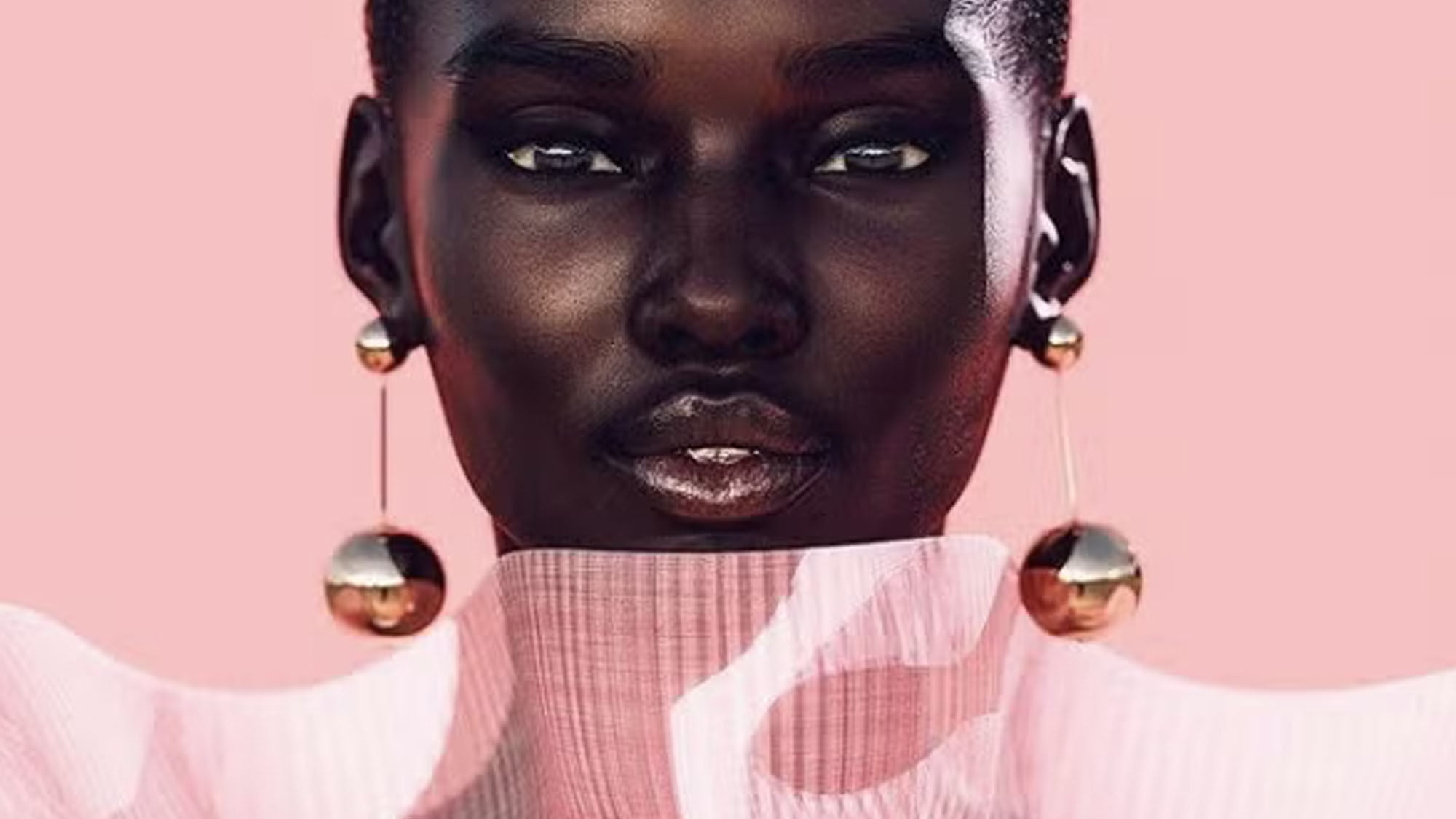
For decades, brands have relied on beautiful people to sell beautiful things. Fashion models, actors, athletes, and everyday individuals have helped give products personality, aspiration, and emotional resonance. The right face could define a campaign, establish a cultural moment, or make an otherwise ordinary product extraordinary.
Now, that face doesn't have to belong to anyone.
Artificial intelligence has made it possible to create photorealistic models who have never existed, wear clothing they've never touched, and inhabit environments that have never been built. They don't need makeup artists, photographers, stylists, travel arrangements, or lunch breaks. They can be any age, ethnicity, body type, or personality a creative director imagines.
And they can be endlessly perfected.
For brands, the appeal is obvious. For the people whose livelihoods depend on creating these images, the implications are considerably more complicated.
The question is no longer whether AI-generated models will become part of advertising. They already have.
The more important question is whether they should—and under what circumstances.
The promise of synthetic perfection
From a production standpoint, AI-generated models offer extraordinary possibilities.
A fashion brand can visualize an entire seasonal collection without organizing a traditional photoshoot. A retailer can experiment with different environments, lighting, styling, and model characteristics before committing to production. A small business with limited resources can create polished campaign imagery that previously would have required a substantial budget.
AI can also make visual experimentation faster and less expensive, giving creative teams more freedom to explore ideas that might otherwise never reach the presentation stage.
There are potential benefits for consumers, too. Imagine being able to see clothing on a broader range of body types, ages, and appearances rather than relying on the narrow standards traditionally favored by fashion advertising.
In theory, AI could democratize representation.
But there's an important distinction between depicting diversity and actually supporting it.
A brand might generate images of people from a wide range of backgrounds without employing asingle person from those communities. What appears to be progress in representation could, paradoxically, become another form of exclusion.
Diversity without participation is not necessarily inclusion.
The human cost of artificial beauty
The economics of AI-generated imagery are difficult to ignore.
A traditional fashion shoot creates work for photographers, models, stylists, makeup artists, hairstylists, producers, assistants, location managers, and postproduction specialists. Even relatively modest campaigns support an ecosystem of creative professionals.
When an entire campaign can be generated from a computer, some of those opportunities may disappear.
This doesn't mean AI will eliminate the creative industry. Photography survived the arrival of digital cameras. Graphic design adapted to desktop publishing. Filmmaking evolved through computer-generated imagery.
But those comparisons only go so far.
AI is different because it doesn't simply change the tools creative professionals use. In some applications, it can replace the subjects, environments, and production processes themselves.
And that creates a more fundamental question about the value we place on human creative contribution.
If a brand can manufacture a convincing image of a person for a fraction of the cost of photographing one, what incentive remains to hire the real person?
Perhaps the answer lies in recognizing that the value of a model extends beyond physical appearance. Real people bring individuality, lived experience, cultural relevance, personal identity, and emotional expression to the brands they represent.
Those qualities aren't always easy to quantify on a production budget. But they can be central to building meaningful connections with an audience.
Authenticity in an artificial world
There is an irony at the center of this debate.
At the same time that brands increasingly talk about authenticity, transparency, and human connection, they are gaining the ability to manufacture increasingly convincing human experiences.
A model smiles at the camera. Her hair moves naturally in the wind. The sunlight catches her face.She appears confident, spontaneous, and effortlessly beautiful.
Except she was never there.
Does that matter?
In some circumstances, perhaps not. Advertising has always involved artifice. Images are carefully composed, lighting is manipulated, imperfections are retouched, and entire environments are constructed to create an idealized reality.
Consumers generally understand that advertising is not documentary photography.
But AI introduces a new distinction: the difference between enhancing reality and inventing it entirely.
When a brand uses a synthetic model without disclosure, consumers may reasonably assume they're looking at a real person. That assumption becomes particularly significant when the brand is selling ideas associated with identity, beauty, wellness, lifestyle, or personal experience.
The issue isn't simply whether the image looks real.
It's whether the brand is being honest about what the image represents.
Authenticity is not necessarily about showing everything exactly as it is. It's about being truthful about what you're presenting.
When innovation becomes controversy
Several major fashion brands have already discovered how complicated this conversation can become.
In 2023, Levi Strauss & Co. announced a partnership with Lalaland.ai to explore AI-generated models.The initiative was initially associated with increasing representation in online shopping, but critics questioned why the company wouldn't simply hire more diverse human models. Levi's subsequently clarified that the pilot was not a substitute for genuine diversity initiatives.
In 2025, H&M introduced AI-generated digital twins of real models, with the intention that participating models would retain rights to their digital likenesses. This approach offered a potentially more ethical model for adoption, but still raised concerns about employment opportunities for the broader production industry.
That same year, Guess generated controversy when an advertisement featuring an AI-created woman appeared in Vogue. The imagery was convincing enough to raise uncomfortable questions about whether consumers could distinguish real models from synthetic ones—and whether they should have to.
The debate has now moved beyond hypothetical job losses. An October 2026 Reuters investigation documented proposed modeling contracts that would permit digital cloning, facial alterations, and AI training using models' images, sometimes without additional compensation. The technology is evolving faster than many of the protections surrounding it.
These examples illustrate something important: consumers and creative professionals are not necessarily rejecting technological innovation. They are questioning how responsibly that innovation is being implemented.
The danger of a world without imperfections
Perhaps the most fascinating—and troubling—aspect of AI-generated models is their potential to redefine beauty standards.
Fashion photography has long been criticized for promoting unrealistic physical ideals. Retouching software made it possible to smooth skin, reshape bodies, and eliminate virtually every visible imperfection.
AI takes that process to its logical extreme.
Instead of modifying an imperfect human, we can now create a person who was never imperfect in the first place.
Every feature can be optimized. Every proportion adjusted. Every expression engineered to appeal to a particular audience.
But what happens when the people we see in advertising are no longer constrained by human biology?
Real people age. They have asymmetrical faces, distinctive features, changing bodies, and physical characteristics that make them recognizable and individual.
Those differences are not necessarily flaws. They are often what makes someone compelling.
A world of algorithmically perfected faces risks creating a new standard of beauty that no living person could reasonably achieve.
And if brands increasingly depend on the same generative tools, trained on overlapping visual references and optimized for similar aesthetic preferences, advertising may also become more homogeneous.
We could find ourselves surrounded by an endless supply of beautiful images that somehow all look the same.
The case for collaboration, not replacement
The strongest argument for AI in creative production may not be its ability to eliminate human involvement, but its potential to extend human capabilities.
Consider a model who licenses a digital version of herself to a brand. She retains control over how her likeness is used, receives compensation for each approved application, and can participate in campaigns across multiple markets without physically traveling to every location.
Or consider a photographer who uses AI to extend an original shoot into imaginative environments that would be prohibitively expensive or impossible to construct.
These scenarios preserve a meaningful role for human talent while embracing the advantages of emerging technology.
But they require thoughtful standards around consent, ownership, compensation, disclosure, and creative accountability.
They also require brands to distinguish between using AI to expand creative possibilities and using it simply to eliminate production costs.
Both approaches may improve efficiency.
Only one necessarily contributes to a more sustainable creative ecosystem.
What should brands do?
For brand leaders and creative agencies, the decision to use AI-generated models should begin with strategy rather than technology.
The fact that something can be generated quickly and inexpensively doesn't automatically make it the right choice for a brand.
A luxury fashion house built around craftsmanship, heritage, and individuality may undermine its positioning by replacing human talent with generic synthetic imagery.
A technology company exploring the future of digital identity, on the other hand, might find that AI-generated characters are entirely consistent with its brand story.
Neither approach is inherently right or wrong.
What matters is the relationship between the creative execution, the brand's values, and the expectations of its audience.
Brands should consider several fundamental questions before adopting synthetic models:
- Transparency: Are consumers being clearly informed when an image depicts an AI-generated person?
- Consent and compensation: If a real person's likeness is involved, have they authorized its use and been fairly compensated?
- Representation: Is AI expanding genuine inclusion or merely creating the appearance of diversity?
- Creative integrity: Does the technology strengthen the brand's storytelling or simply reduce production costs?
- Brand trust: Would customers feel differently about the brand if they knew how the imagery was produced?
These are not simply legal or technical considerations. They are brand decisions with long-term reputational consequences.
The future is human. Even if the images aren't.
Artificial intelligence is not going away, nor should it. Its potential to transform creative production, expand accessibility, and unlock new forms of visual expression is too significant to dismiss.
But technological capability should never be confused with creative judgment.
A beautiful image is not necessarily a meaningful one. A perfectly rendered face is not necessarily a compelling personality. And an inexpensive campaign is not necessarily an effective one.
The brands that succeed in this new environment will be those that understand the difference.
They will embrace AI where it adds genuine value, protect the people whose creativity makes their brands distinctive, and remain transparent about the experiences they present to consumers.
Because ultimately, branding is not about manufacturing perfection.
It's about creating connection.
And in a world where almost anything can be artificially generated, being genuinely human may become a brand's most valuable differentiator.